WHAT WE ARE SOLVING NOW
Helping every child reach their full potential.
Every child has a peak of its potential. Almost nothing in the system is built to get them there.
The Problem
Most mental health systems wait for children to fall behind before offering help — and even then, standard care rarely fits the individual. In that void, vulnerable youth don't just falter; they become susceptible to deep self-deterioration and extreme real-world harms.
Tracing the roots
1 in 7
children aged 10 to 19 is living with a mental disorder. That is roughly 166 million young people. The World Health Organization's own note on them: largely unrecognized, largely untreated.
520M
children, more than 1 in every 5 on earth, are growing up inside a conflict zone — an all-time high.
Annual government spend on mental health, per person
High-income countries
$66.00
Low-income countries
$0.04
Bars drawn to true scale. The low-income bar is 1/1650th of the high-income bar.
Where it comes from
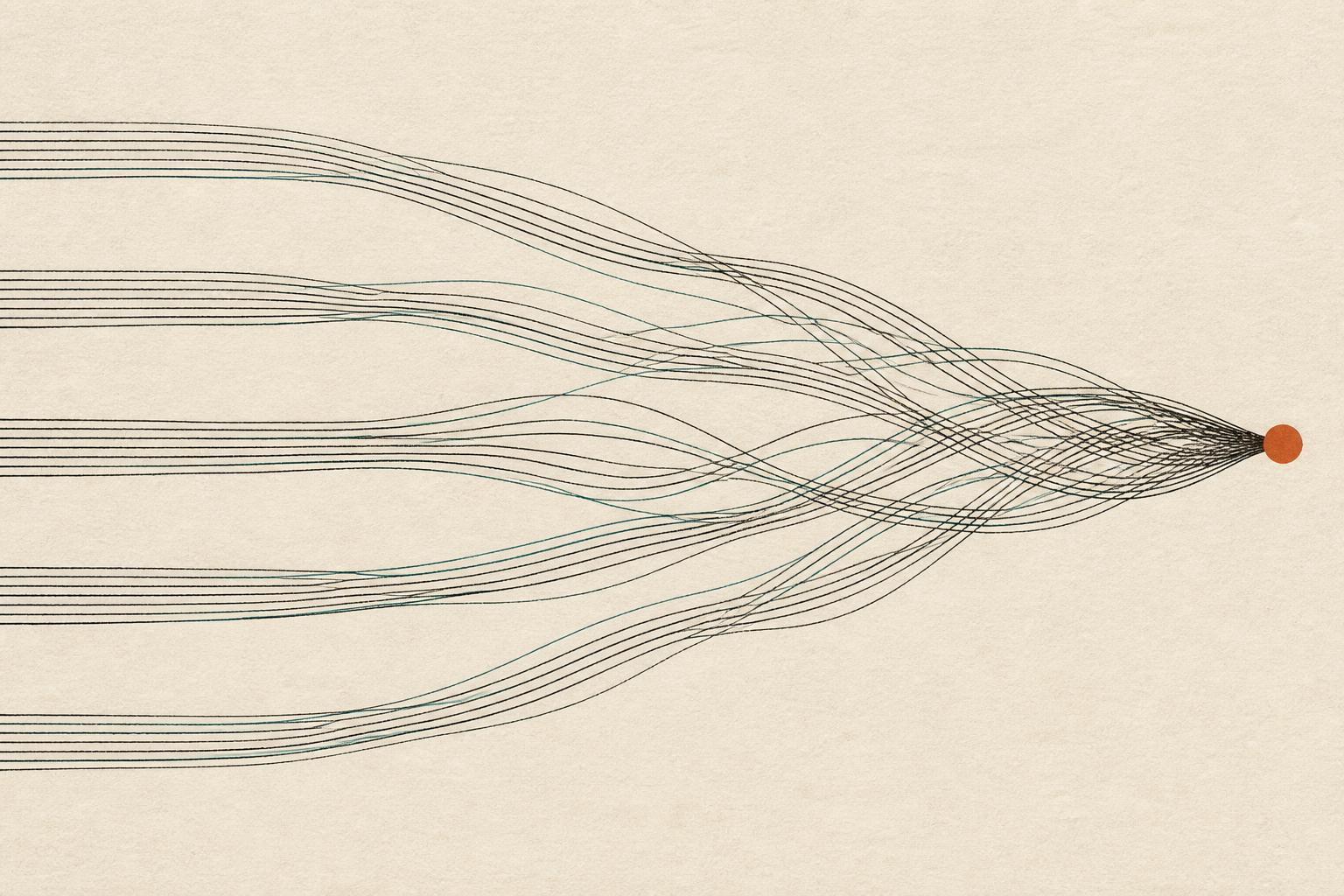
Five different sources, all leading to a young mind.
01 ·
Attention and addiction
02 ·
Violence, loss and displacement
03 ·
The household under strain
04 ·
Abuse, isolation and exploitation
05 ·
And then there is no care in times of need
A screen, a war, a household, a person who meant harm, and a system that only looks up when the damage is loud enough to be filed under something else. By then a childhood has already been spent waiting.
So the Center starts at the root.
The first Lab takes the mental well-being and trauma of children and young people, and asks the question the whole chain depends on: what can be read early enough to matter, and how, while a school stays a school and a clinic stays a clinic.
Get that right and every stage downstream gets easier. Get it wrong and the rest of the system spends its life catching children who have already fallen.
The Center & its governance
The solutions to solve this problem exist. What has been missing is the technology and the institution around it.
Steering committee
A steering committee of founding partners and senior sector leaders sets direction, approves every Lab, and holds the Center to a scope that will come under pressure to widen.
Rotating host · 2-year term
The Labs are hosted by a lead organization running its secretariat for a 2-year term. Hosting rotates, and every area stays open to a new host, including the areas the founding partners know best.
Open by default
Everything the Labs produce is open and free. Every framework we publish has survived a real deployment. Every contribution is credited to the organization that built it, wherever it travels.